Though my father’s last word, always rang in my ears, I could not fulfil his wishes immediately, because I had to battle financial crunch.
On 1922, I was released from Tezpur jail. I had no home, no shelter, I had no inkling as
to where to go. In the end, I went to Baan theatre. On the way, I met the Late Radhika
Mohan Das, the long standing Chief Secretary of Baan Theatre. I stayed with Jyoti Prasad Agarwala, who was like a brother to me. I composed music for the play Sonit
Kunwari .It was then that the idea of printing these new compositions of Assamese tunes
on a Gramophone Record struck me. Towards that, I worked tirelessly but in vain. I had
to face a lot of obstacles. These new Assamese melodies could reach out to only a few
people. Some ridiculed, some despised and others were indifferent.
In the year 1924, I set out for Calcutta in search of something new, with deep desire and
determination to record Assamese songs on the gramophone and to learn music. I
started out as mechanical apprentice in a factory in Beliaghata in the then Eastern
Bengal Railways. My monthly salary was Rs 30. I used to work in the factory from eight
in the morning to four in the evening. Sometimes I felt like leaving my job. But that was
not possible. For that would never serve my purpose of staying back in Calcutta and
fulfilling my dreams The road that I used to take to walk from Sealdah station to the
Belighata rail factory, where I worked, also had a factory of a Gramophone company
situated there. Everyday, this H.M.V. factory, reminded me of my own dream of
recording songs on the Gramophone.
One morning like always, I was on my way to work. I told the watchman that I wanted to meet the head, the Burra Saheb of the factory. The watchman forwarded the
packet of visitors forms. After filling in my name and the information that I wanted to
meet the general manager, I was stuck halfway when I had to write the purpose of my
visit. I wrote that I want to record Assamese songs. The watchman asked me to sit in
the waiting room and sent my form to the Burra Saheb. I was dressed in a Khaki half
pant and an untidy shirt. That was my factory uniform. This attire definitely did not suit a musician on his way to record a song. I thought it was better not to meet the Burra
Saheb now and was about to leave when the Saheb called me. When I entered the room the Saheb asked me, "Assamsese people like to sing Bengali songs. Don’t they? Will
Assamese records sell? Is the Assamese population large enough?"
I replied. "Please try and make a record of Assamese songs. Nowadays, there is an increasing popularity of Assamese songs." In the end the Saheb asked, "Where is the singer? If the singer is
ready to pay for his airfare to Calcutta, I will consider the case." I replied, "Saheb, I am the singer, I want to make a record." The Saheb looked at me and said, "Your voice
needs to be tested. You will be informed by mail." When I reached my place, the entrance to the rail factory was closed. So I went back to the hotel and wrote a sick report. Two
days later I received a letter from the gramophone company. I was asked to report for
an audition at the company’s 106 Upper Chitpur Road rehearsal room.
A certain day in
the month of August or September in 1924 I arrived at the three storeyed building
where the HMV gramophone company’s rehearsal room was situated. I was asked to sit
in a room on the second floor. There were many smaller rooms nearby. Some time later,
a middle aged man walked in. He asked me my name. He wanted to know where I had
learnt music, for how long and under whom I received the training. Just then, one by
one, men and women from the other rooms entered the room. Most of them were
singers who sang for gramophone records. Because I was new they had come to see how
I sang. The middle aged man who had been asking me questions requested me to sing. I
was nervous. At that moment, I was reminded of my cherished determination of making
an Assamese gramophone record. I sat down and played my tune on the harmonium.
With great courage, I began to sign the song Oxoma Nirupama Jononi Oi Olonghya Giri
Durgarani. The man who had been asking me questions accompanied me on the tabla. I
came to know later that the famous singer was Monta Ghosh, the instructor of the
gramophone company. When I completed my song, everyone clapped. I could not gauge
whether my song was liked or not. After a moment's silence Monta Ghosh asked me to
sing another song. This time I sang the Bengali song Arnai Shokol Rokome Kangal
Korecho Garbo Korite Chur. This time I got a louder applause than before. I understood
that this time my song was better in comparison to the first. Monta Ghosh gave me a
cup of tea and poured one for himself as well. In the meantime the other singers, both
men and women slowly left the room. I felt relieved. While drinking tea I forced myself
to ask Mr Ghosh what was the result of my test.
After four to five days I received a letter
in which it was stated that they decided to record four Assamese songs with me. I was
really excited. I went to the Gramophone Company’s Upper Chitpur Road rehearsal room
and began to select and rehearse the songs that I would record. Monta Ghosh, the man
who trained me did not approve of the songs that had duo puro and authonlo song of
Assamese melody. He told me that these would not be commercially viable. In the end,
the songs that we considered in line with modern tunes were approved for my record.
In those days there were no means to record a song in microphonic or in electronic way.
Songs were recorded through mechanical means. The recording took place in Beliaghata
factory’s three storied building.
The person who was working on the gadgets was an Englishman. Others were not
allowed to enter that room. Perhaps that was the trade secret of the company. I brought
the harmonium in front of me and Monta Ghosh sat down near me with the tabla. I was
asked to sing each song for a duration of three minutes. I had rehearsed the songs
beforehand. But we rehearsed it there once again. The moment the red light was
flashed, I began my song and completed it within three minutes. After a pause, I started
the second song. All the four songs were recorded in an approximate time of one hour.
I then returned to my boarding house. It was indeed a historical moment. My dreams had turned to reality. But I had no idea how the recording had been. I spent the following
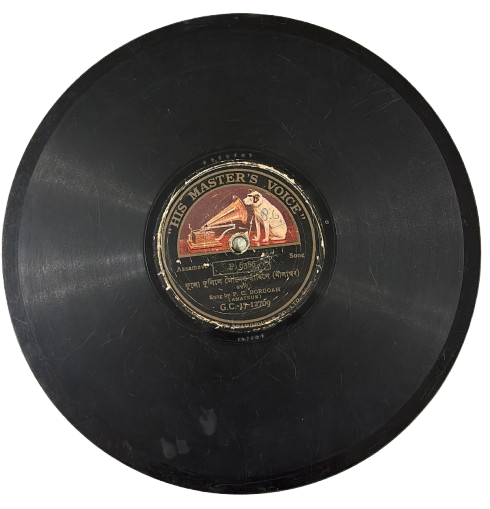
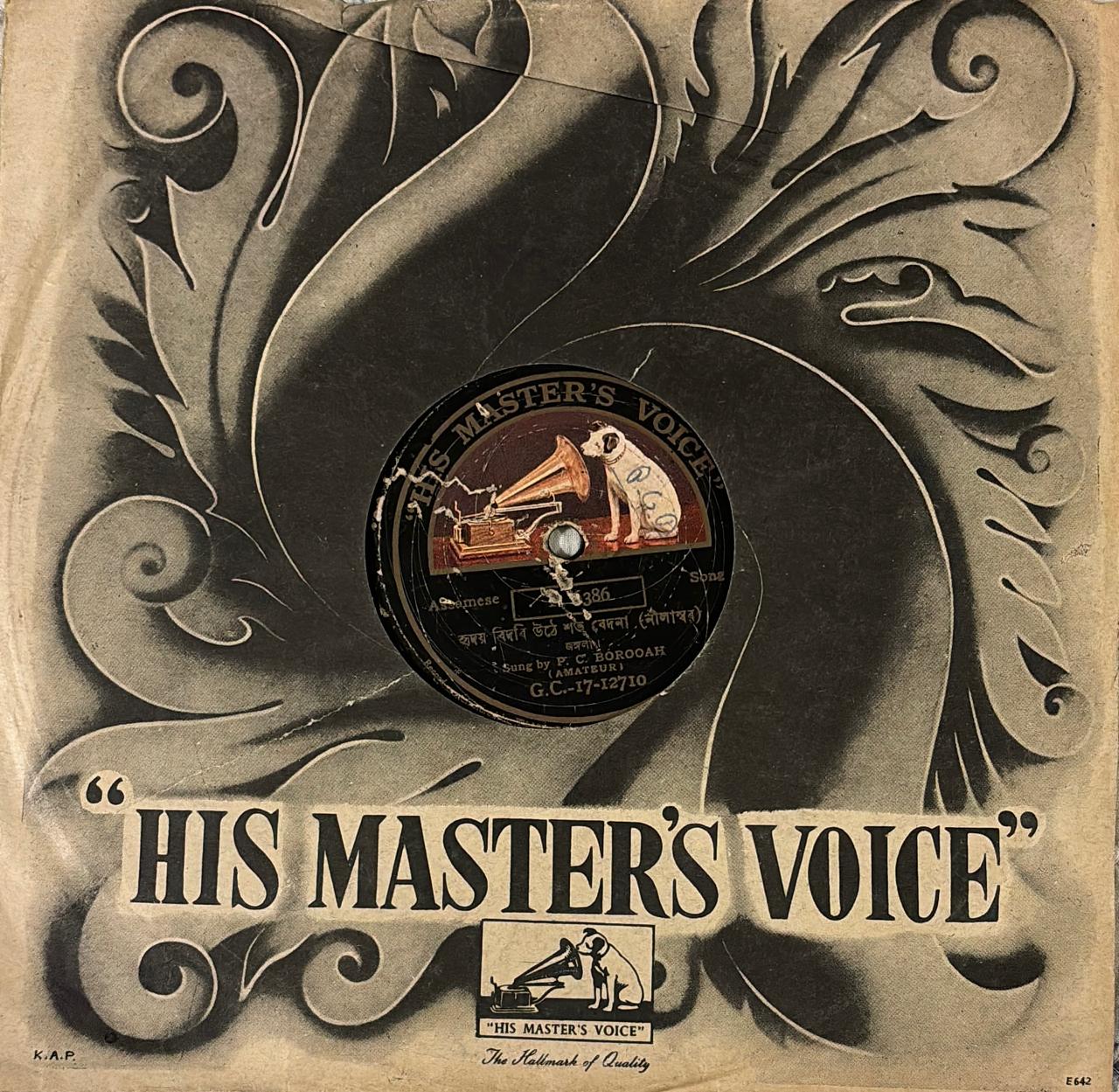
days in anxiety. One day I got news that I had to go to the factory to fetch four complimentary records. These complimentary records had songs recorded only on one
side. I could not imagine that I was hearing my own voice.
Courtesy: The Sentinel