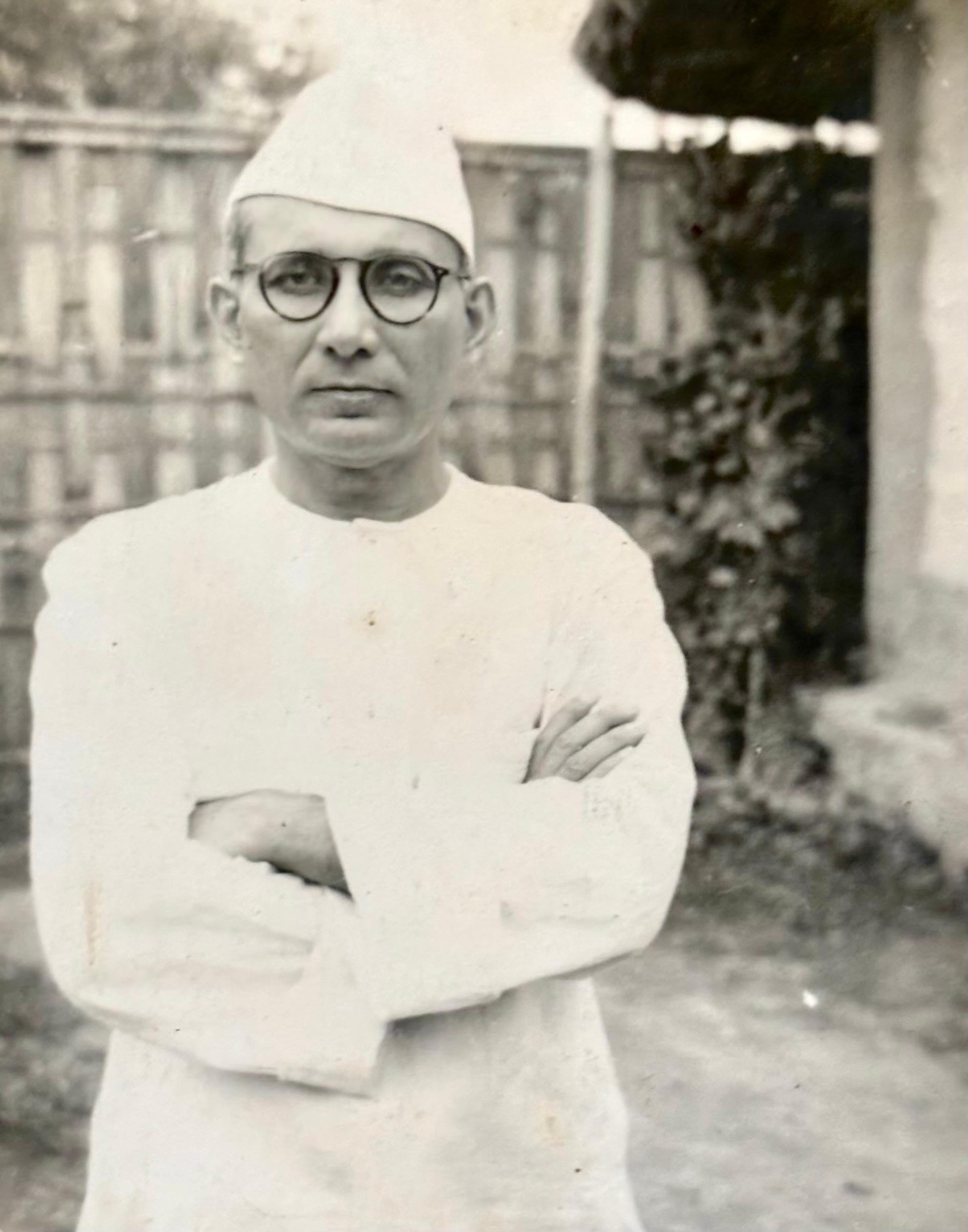
Prafulla C. Borooah was born on 7th March, 1900 in Dhubri, lost his mother at the age of 5 and
father at 14. He had his schooling at a 'sister-dead- brother-in-law's house at Mangaldoi.
Prafulla was a talented boy and that talent was nurtured by a glorious cultural inheritance,
humanism and a sense of nationalism-the ideals of his father.
The history of Assam in the later part of the 19th century witnessed a strong birth-pang. A great
nation had been destroyed. There was darkness everywhere. Civil war, foreign invasion colonial
subjugation, degeneration- that was an era of gloom. Modern Assam took birth through that
ordeal. This modernity was manifested through an urge for cultural regeneration, for
establishing and developing Assamese art, music and literature. The birth struggle of modern
Assam created those venerable pioneers like Lakhminath Bezbaroa, Lakshmiram Borooah and
the like.
Prafulla Borooah, Jyotiprasad, Ambikagiri and others were the second generation warriors of
that historic war. That is why we see in their life-works a spark of the indomitable spirit of
renaissance. Prafulla Borooah believed and followed these ideals : "Dare to go where no one
had been to, see what others avoid seeing, hear what others have not heard, think what others
think to be unthinkable- only then will the divine blessings descend to your life. Live life in its
fullness!"
P.C Borooah's life was a perfect stuff of biography where his story merges to history, history of
the making of a modern Assam.
P. C. Borooah was a good student. Having lost parents early in age with no house to dwell in
and no means of livelihood he had to roll on different places like Tezpur, Shillong, Dibrugarh
and Mangaldoi. He passed Matriculation in 1918 from Mangaldoi and I.Sc. in 1920 from Cotton
College. After that he joined Ripon College in Calcutta. He was a third year science student of
that college in 1920 when he came into direct contact with the freedom movement of India. His
studies got interrupted. He read up to 4th year B.Sc. in Ripon and after a gap of two years went
to Benaras Hindu University for B. Sc. Engineering. He studied there for two years. The
relatives and well-wishers bore all the expenses.
While studying at Ripon College in 1920 a special session of the Indian National Congress was
taking place in Calcutta. That was a prelude to historic Nagpur session where India's treedom
movement entered its decisive stage. The Calcutta session also marked the arrival of Mahatma
Gandhi on the centre-stage of the movement. Gandhi's ideals of non-violence and non-
cooperation had already created a mass upheaval across the country. The third year student
Prafulla 'nourished a terrible urge to see' the session and the national leaders from close
quarter, being present right inside the venue. That was not possible, because only elected
delegates would be allowed into the venue. There were no provisions for general public, non-
delegates or uninvited persons to get inside.
What followed is a story worth telling. Prafulla dared to think what others thought to be
unthinkable. He observed the whole arrangement very minutely and suddenly found that there
had been a provision for a press gallery for authorized journalists. So, he has to be a journalist.
How could it be possible? He found a way to make this possible. He sent a telegram to
Padmanath Gohain Barua of Tezpur, who was somehow running an Assamese weekly named
Ason Bonti requesting him to send an authorization letter in his name assigning him as a
reporter of the weekly for doing the coverage of the session for his paper. A stalwart like Gohain
Barua appreciated the idea and promptly sent the authorization letter to Prafulla. Ile procured
not one but two entry passes, one for a friend, from the president of the reception committee
who belonged to the Kipon College fraternity. Prafulla and his friend gleefully occupied two
seats of the front row alongside the top all India leaders: Ile minutely watched the entire session,
from start to end.
He became an ardent follower of Gandhiji's path and vowed to take active part in the freedom
struggle. This unique adventure made him very popular among the students of Ripon College
who elected him as one of the four delegates to represent the college at the first session of the
All India College Students Conference to be held at Nagpur at the same time with Congress
session which would endorse or reject Gandhiji's call of "complete independence or complete
non-cooperation with the British Government". That students'; conference was an important
event P. C. Borooah was right on the door step of becoming a national level student leader.
Ripon College was an influential institute. P. C Borooah had the steely quality of a young leader.
He spoke fluent English and knew history and politics well. At that time something unexpected
had happened. A crucial session of the Assam Association, the only political organization of
Assam in those days was called at Tezpur. As a good host the people of the town organized a
theatrical performance in honour of the delegates.
They summoned P. C. Borooah to play the lead role. His mind dwindled. An elected delegate to
an all India conference of historic proportion versus playing a role in a drama at Tezpur. Such
occasions reveal a person's true colours. He opted for Tezpur. That was really a sort of
renunciation that very few people could make.
Let us sacrifice
On returning to Calcutta P. C. Borooah wrote a letter to the principal of his college which was
run by the British Government. The substance of the letter was that he is going to give up
attending the college from then on in protest of the blood-shed of Indians by the British
Government. The letter got front page coverage in the widely circulated Amrit Bazar Patricka.
That created a stir among the students. In a couple of days the whole of the colleges of Calcutta
were on strike. In next couple of days same thing happened in Guwahati and other places. He
was the first student in the entire country to have struck college for joining the freedom struggle.
He was arrested in Mangaldoi for his seditious act by a contingent of army and police personnel
led by the European D. C. and accompanied by the S.P. which indicates that the Government
treated him as a high profile prisoner. He was offered special treatment in jail which he refused
to accept. He was convicted for six months rigorous imprisonment. The jail personnel often
resorted to physical torture, ill-treatment and deprivation of the prisoners. He warned the jail
authority (of Tezpur where he was detained) that he would not tolerate any form of ill-treatment
and injustice to the prisoners. On one occasion he even rushed to the jailer to assault him. The
jail authority threatened him to be beaten up by a cane according to the Jail Manual. He roared
back like a wounded lion: "I do not care a hang for caning. I will not be satisfied less than the
death sentence. I will be second Kanhailal Bose whose body weight got increased by five
pounds by the time he was hanged. Let the jailer know that I am non-violent in the open, but
inside jail I will be violent if meted injustice." No, the authority did not dare to cane this fearless
fighter for justice. One day while objecting to some misbehavior of the jail staff he got so angry
that he threw an iron plate to the face of the jailer. He was put to deadly solitary cell till release.
He was put to jail for longer terms in the following years also.
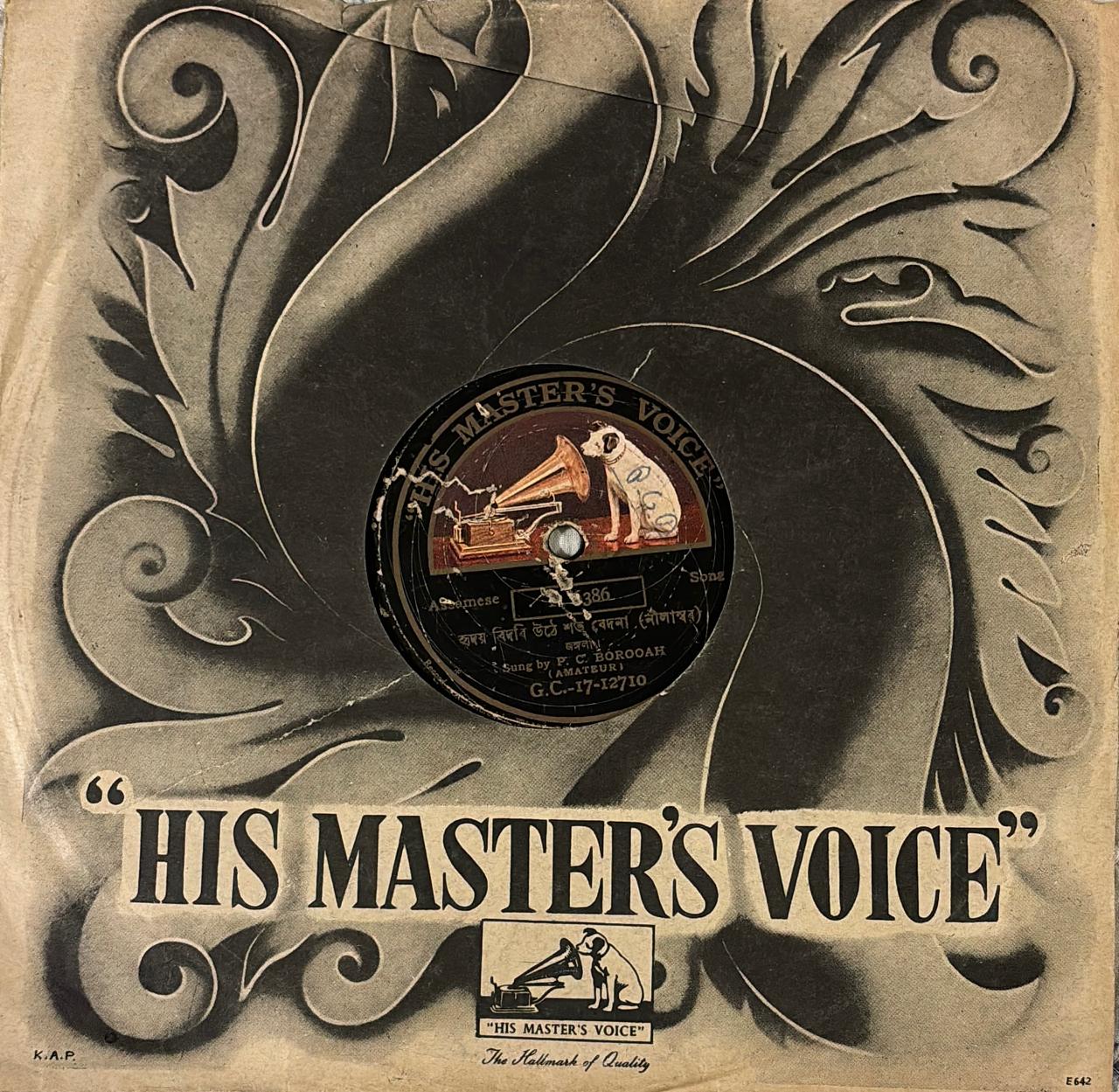
First Assamese Gramophone Record Singer (1924)
We saw this fire-brand young freedom fighter in Tezpur jail. Now we shall see him in a
completely different avatar. He was released from the jail in 1922. But where will he go from
there? He had no home, no shelter, no money in pocket, without means of livelihood. He was so
hard pressed by poverty that he had to ask somebody for a square meal. Seeking a shelter he
proceeded towards Baan Stage and met Radhika Das, the long time secretary of the institution.
Mr. Das told him that he could stay at his house for some days. He accepted the offer and along
with his close friend Jyotiprasad took part in tuning the songs of Sonit Kunwari- a drama written
and directed by Jyotiprasad. It was a completely new type of experiment. These songs, written
in modern Assamese, were based on the tunes of traditional folk tunes of Biyanam, Aninam and
Bihugeet. That was a unique experiment of modern Assamese song. But majority of the people
did not encourage it much at that time. An idea came to his mind -why should not these new
Assamese songs be recorded on gramophone.
This dream was dreamt by none other than his father. Lakshmiram Borooah planned a visit to
Calcutta in 1914 with three tasks: to record some Assamese songs, to print a book written by
him on Western, Indian and Assamese music and to sit for an admission test to Trinity College
of Music of London. But a few days before his journey to Calcutta he fell suddenly ill and passed
away. In P. C. Borooah's own admission his father urged him just a few minutes before his
death to fulfill these unfinished tasks. He never forgot his father's last wishes and his command
to him. But poverty did not allow this to happen.
In 1924 he went to Calcutta with the twin objective of finding a job there and to record
Assamese songs. He managed to get a small manual job at a factory for a monthly salary of Rs
30. From 8 am to 4 pm he had to work hard and without any provision to sit. Four years ago he
left this same city as a budding student leader of a prestigious college. Well, if this is called 'fate'
so be it. Sometime later his salary was increased to Rs. 35 and he shifted to another house. To
his surprise it was near the gramophone company.
One day while going to his office his indomitable desire to record Assamese songs had diverted
his walk towards the gramophone company. As if in dreams he proceeded to enter the office.
The watchman stopped him and then only he realized where he was standing. He was smart
enough to command the situation and said, 'I want to meet the officer.&'' The watchman asked
him to fill up the entry form and wait in the visiting room. At that time P. C. Borooah was wearing
the uniform of a factory worker-a khaki half pant and a filthy shirt. He felt a bit awkward. He had
already written in the entry pass that he had come for the purpose of recording songs. Is this the
way to dress for a singer? What to do now _ should he depart and come another day with some
preparation and in a decent dress? While all these thoughts were around his mind he was called
by the officer and asked about the purpose of his coming. He replied that he was planning to
record some Assamese songs. "Who will buy Assamese records ?he asked. Assamese people
are very less in number and they love to hear Bangla songs." Lot of things he said. Borooah
said, "just try it for once. Assamese songs are getting popular now-a-days."
Finally the officer asked, "But where is the singer? If he comes at his own expenses then we
can think of it." Borooah said that he was the one. The officer curiously observed him and said
that they have to test his voice first. That day his duty hours got over. He might lose the day's
salary. He submitted a sick report. At this stage he cannot afford to lose the job. After a couple
of days he received an invitation from the gramophone company for voice test.
Borooah went for the voice test. There were a number of people in the room where he was
asked to sit. One person first questioned him about some basics and then asked him to sing. He
put his fingers on the harmonium; the person who was asking him questions took up the Tabla.
He later came to know that his name was Masta Ghosh, the famous singer and instructor of the
gramophone company of that time. Borooah was quite nervous and tense because a number of
people, most of them singers and musicians gathered around to listen the singing of a novice.
Borooah started, 'Asoma nirupoma oyi alonghogiri durgo rani.' As he finished, everyone gave
him a huge applause and requested for one more. The Bengali audience in the studio loved and
accepted P. C. Borooah's singing of Assamese songs. He was very delighted and started a
Bangla song, Amay sokol rokome kongal koreso garbo karite chur. He was greeted with more
applause. Masta Ghosh seemed to be satisfied but did not disclose much. He offered tea and
promised to let him know as early as possible.
He passed next several days in great anxiety. He gave up hope on the fourth day. He could not
concentrate his mind on his job. But the letter had come _ an invitation to record four songs.
Rehearsal began. He sang in pure Assamese. At first Masta Ghosh had rejected them saying
that they will not get to the market. Finally four songs were selected. Masta Ghosh had coached
him well.
He instructed to sing loud and with clear pronunciation. In those days there was no microphone
or electronic systems. Rehearsal was done for about seven days. Three minutes were given for
each song and there was no provision for any change or correction. He rehearsed accordingly.
The four selected songs were: 'Hridoy Bidari LIthe Sata Bedanare', 'Phoolu phoolile joneu
hanhile banhie dhorile taan', 'Sirokal tumi asila swadhin' and 'Asoma nirupama janani.'
Recording was done. Again the tension began. He used to meet Masta Babu almost every day.
One day he was informed to come to the recording factory to collect the sample copy. It was in
the terms and conditions that the singer has to approve the first copy, only then the company
will produce the bulk of records and release them to the market. Masta Babu himself played the
record to Borooah. What a moment it was! This was the beginning of a new era of modern
Assamese music. First gramophone record of modern Assamese song was done .The dream of
Lakshmiram Borooah was fulfilled by his son. It was a dream come true for P. C. Borooah
himself. He writes about the experience in these words: 'I was spell-bound when I got to hear
my voice on the gramophone machine.' The Gramophone Company released the record in
1924.
It created a wave of joy among Assamese music lovers. By that time the seventh session of
Asom Sahitya Sabha was held at Guwahati. Rasaraj Lakhminath Bezboroa was the President.
The first record of Assamese song was played there. Bezboroa was overjoyed to hear the
songs and expressed professedly his delight in composing these songs in pure Assamese
tunes.
P. C Borooah was present there. He sang a song from Jyotiprasad Agarwala's drama Sonit
Kunwari : 'Gose gose pati dile phoolare sarai ki ram o ram phoolare sarai. Sahityarathi was so
moved that he expressed his feelings in these words: "only today have I heard a song which
touched my heart and soul. This song has given me abundant joy." This song was based on the
tune of indigenous Assamese Biyanaam, was composed by Jyotiprasad and accompanied by P.
C. Borooah.
Aaji Bondo Ki chandere
This song, written by Ambikagiri Raichoudhury is one of the most memorable Assamese
modern songs. The song was tuned by P. C. Borooah. The story behind it is noteworthy. It was
in 1926. The plenary session of Indian National Congress was held at Pandu where Mahatma
Gandhi, Motilal Nehru, C. R. Das, Sarojini Naidu and other leaders were present. Tarunram
Phookan and Nabin Ch. Bordoloi were president and secretary respectively of the reception
committee. P. C. Borooah was the secretary of the 'music, reception and procession sub-
committee'. P. C. Borooah suggested Ambikagiri to write the welcome (opening) song and took
the responsibility of tuning the song by him. Ambikagiri wrote it and called P. C. Borooah to his
place and urged him, “Prafulla, give it such a tune which make our guests mesmerized”.
Borooah read the song. He read it over and again. On his fifth reading a tune spontaneously
burst out from his mouth and that tune mesmerized the creator himself. Hearing the tune
Ambikagiri could not control his emotions. He hugged P. C. Borooah and said to him, “as an
elder I bless you. This tune would be immortal”. P. C. Borooah also told him, 'Dada, this lyrical
poem by you would remain forever' .The song was: 'Aaji bando ki chandere samagata birata
Naranarayana rupa.' The song was presented as a chorus by 50 well-dressed singers in front of
thousands of people in the Pandu INC session. The song created a magic spell among the
audience. Dr. Banikanta Kakoti translated the song into English which was distributed to the
audience beforehand. That helped the non-Assamese audience to realize the meaning of the
song. Later in 1942 Dr. Kakoti translated some other songs written by Ambikagiri and those
were published in the form of a book titled Song of the Cell.
P. C. Borooah was a close associate of Jyotiprasad Agarwala who treated him like his own
brother. Particularly in the early phase of Jyotiprasad's musical creation and composition of
songs in the line of the indigenous Bia-naam, Ai-naam tunes which revolutionized the sphere of
Assamese songs.
P. C. Borooah was a constant companion of Jyotiprasad Agarwala . P. C. Borooah tuned the
last song of the film Joymati-Luitor Pani Jabi-O Boi. Jyotiprasad requested him to give such a
tune to the song that it could make viewers of the film leave auditorium with tears.
Jyotiprasad's dream was fulfilled. He was in high praise of the tune.
Borooah was president of the music conference of the Dhubri Session of the Asom Sahitya
Sabha. Not many people know that P. C. Borooah was the first president of Assam Branch.•
Indian Peoples' Theatre Association (IPTA) in 1944-45.
Prafulla Ch. Borooah, M.P.
He was elected to the Lok Sabha twice -1957-62 and 1962-67, i.e, he was a member of the
second and third Lok Sabha. His track record as an M. P. was quite impressive. In the first term
he was ranked as one of the top ten M. P.s in matter of putting questions. And in his second
term he was ranked first having had the honor of putting highest number of (12000) questions
out of which 6000 were admitted. His speeches were also well appreciated.
Although a staunch Congressman he stood stubbornly against the Emergency proclaimed by
the Indira Gandhi led Congress Government. He steadfastly supported the six-year Assam
agitation. He was a man of principle and lofty ideals. He never used politics for expediency.
He will also be remembered as the single biggest donor in Assam to have donated 1000
Bighas land to the Bhoodan Movement launched by Vinoba Bhave in 1960 s.
P. C. Borooah - A Pioneer Tea planter of Assam
As mentioned earlier P. C. Borooah started his life as a factory worker in Calcutta. His monthly
salary was Rs. 30 only. It was in 1924. He joined the INC as early as in 1920, when he was a
student of Ripon College. He was very active in the freedom movement. Therefore he could not
continue his studies. But he had to earn for survival. He was trying his hands in different types
of ventures.
He set up a shop at Panbazar as a dealer of gramophones and musical instruments.
Probably that business did not run well. Still he might have saved some money with which he
purchased a second-hand bus and started passenger service between Guwahati and Palasbari.
Perhaps that too did not click.
He came to Sibsagar and registered his name as a contractor under the PWD. That was a
tough period of his life. Once he got a contract from Assam Tea Company for cleaning the river
Dikhow so that the Company's steamers could move up to Nazira. Company sanctioned five
thousand rupees for the work. Borooah executed the work to the satisfaction of the company
and submitted the bill and payment of five thousand rupees was made. Borooah became very
surprised to see several bundles of notes on the table. He informed his brother Phunu to bring a
trunk to carry the notes. He made a profit of about four thousand. Before that he purchased a
small tea garden of 30 acres in abandoned condition at a sum of Rs. 1200 at a revenue sale.
At the same time he conducted other business also such as supply of Railway sleepers,
bamboo and cane. His cane businesses were very successful and it covered several states. Ile
owned several cane Mahals. With business expanding he ventured into tea business in a big
way.
Several new gardens were purchased and existing ones expanded. Borooah Group of
companies became a big name in the tea industry. They produced quality tea. Management of
the gardens was good. Ultimately he became a major tea planter of Assam, owning seven tea
estates and a reputed tea broking firm.
A brother like Lakshman
Parasuram Borooah was the lone brother of P. C. Borooah. He was more popularly known as
Phunu Borooah. He was an artiste per excellence. He had a good command in music, dance
and drama. Above all he was a good human being-benevolent, dynamic, enterprising. Phunu
Borooah was the first hero of Assamese cinema who played Gadadhar Singha in Jyotiprasad's
film Joymati. He was involved with many social organizations. Like his father he did not finish
his matriculation. However his knowledge of art and culture would put many of the highest
degree holders to shame. And he could speak and write English as his mother tongue. He saw
poverty and struggle from close quarters.
P. C. Borooah's success in tea garden business was mainly due to Phunu Borooah's expertise
and assistance. Phunu looked after the entire business interests of P. C. Borooah. They were a
symbol of brotherhood, like Ram-Lakshman. Phunu Borooah was a tough, stubborn person. But
in front of his brother he would behave like a small child, meekly waiting for his command. He
was more like a son than brother to P. C. Borooah, even beyond that. Phunu Borooah never
entertained any ambition, dream or interest for himself other than standing behind his brother in
thick and thin. P. C. Borooah also took care of his brother and childhood till death they remained
like an undivided soul. Phunu Borooah predeceased him. P. C. Borooah stood like a lifeless
statue near his beloved brother's body and expressed his grief: "82 years we have passed
together. Today only he has separated himself from me!" Blessed are the families where such
bond prevails.
Onto eternity
Prafulla Ch. Borooah passed away on 28th February, 1986 at his hometown Sibsagar, following
a brief illness. He was 86. He left behind him his only surviving son J. K. Borooah. The other
son R. K. Borooah predeceased him.
His wife Hiranyaprabha died after some years of their marriage and second son Ranjit Borooah
also met with an untimely death. His first son Jayanta Kumar Borooah was also a connoisseur
of music. He played violin very well. He was also a very successful tea planter, a distinguished
tea taster of international repute and businessman. He had expanded his father's inheritance to
a new high.
Jayanta Borooah died on 28 September 2011. His wife Lakhimi Borooah passed away on 13
January 2018. They are survived by their two daughters Jahnabi Phookan and Atreyee Borooah
Thekedath.
Jayanta Borooah aru Lakhimi Borooah Sadan, a well equipped hall above Lakshmiram Borooah
Sadan was inaugurated on 11 February 2018 on J.K Borooah's birth anniversary. His daughters
have pledged themselves to the cause of music and hope this Sadan will attract music lovers
from all over to perform there, overlooking the scenic Dighalipukhuri right at the heart of
Guwahati. It was conceived on the lines of Kolkata Town Hall by Lakhimi Borooah.
Original: Krishnamurti Borooah